
Your Clothing Store Has Good Sales—So Why Is There So Little Cash Left?
Sales are high, but your bank balance is low? Discover where clothing retailers lose cash in unrecorded expenses, dead stock, and discounts, and how to fix it.
दुकानात विक्री होते, पण पैसे शिल्लक का राहत नाहीत?
जास्त खर्च आणि नियोजनाचा अभाव
भाडे, पगार, वीज आणि इतर खर्च वाढतात. विक्री वाढते पण खर्चही वाढतो. मासिक खर्चांची नोंद ठेवा.
Your Clothing Store Has Good Sales—So Why Is There So Little Cash Left?
A clothing shop can be busy from morning to evening. New collections arrive, customers visit, bills are generated, and the monthly sales number looks encouraging. Yet when it is time to pay suppliers, salaries, rent, or order the next collection, the bank balance may be surprisingly low.
This situation does not automatically mean the store is unprofitable. It often means that the owner is looking at sales without looking at cash flow, stock investment, discounts, and operating expenses.
Here is a practical guide to understanding where the money goes—and what a clothing retailer can do about it.

Your Clothing Store Has Good Sales—So Why Is There So Little Cash Left? RetailNode Business Guide
2. Small expenses quietly add up
Retailers usually remember rent, salaries, and the major purchases. Smaller items are easier to miss: packaging, delivery, card processing charges, minor repairs, transportation, shop supplies, payment gateway fees, and campaign spending.
If an owner overlooks an average expense of ₹500 per day, that becomes ₹15,000 over 30 days. The amount may be small relative to sales but material relative to the store's actual monthly profit.
Create four expense groups: premises and utilities, people, inventory-related expenses, and administration/marketing. Record the date, purpose, amount, and payment method. Review them every week rather than reconstructing them at month end.
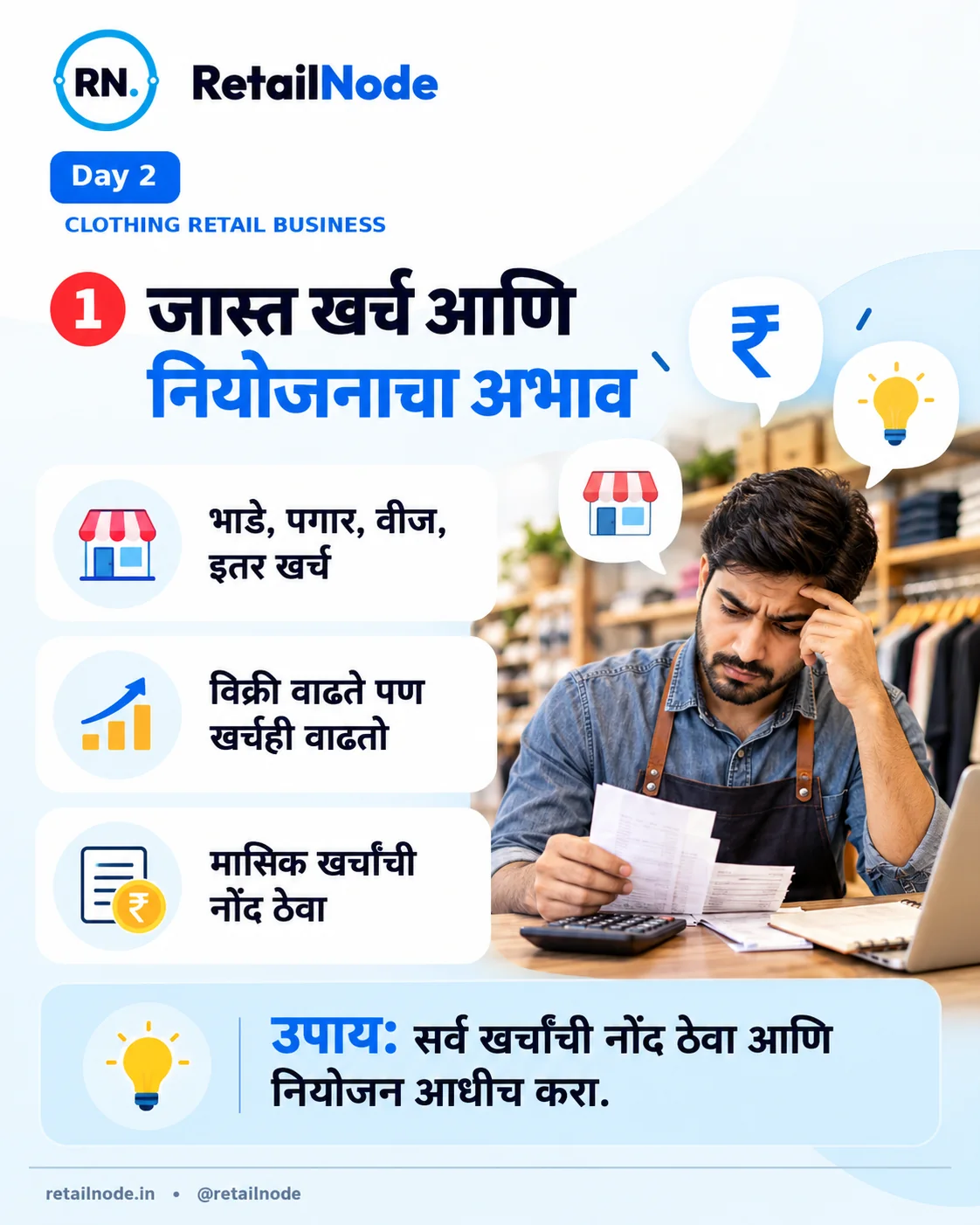
Reason 1: Unplanned operating expenses and small daily leaks reduce retail cash
3. Slow-moving inventory ties up working capital
Clothing demand is rarely uniform across styles, colours, and sizes. A popular shirt may sell quickly in M and L while an unusual size stays on the shelf. Seasonal collections and changing fashion trends make that imbalance more important.
Suppose a store has ₹1,50,000 worth of inventory at cost that has not moved for six months. That does not mean the store has already lost ₹1,50,000. It means capital is tied up in products that have not yet turned into cash. The retailer may struggle to fund fresh arrivals or need deeper markdowns later.
Action: Review stock ageing in 30-, 60-, 90-, and 180-day bands. Inspect size-colour combinations, refresh displays, consider targeted bundles, and decide which products genuinely need a clearance offer. Do not automatically discount everything.
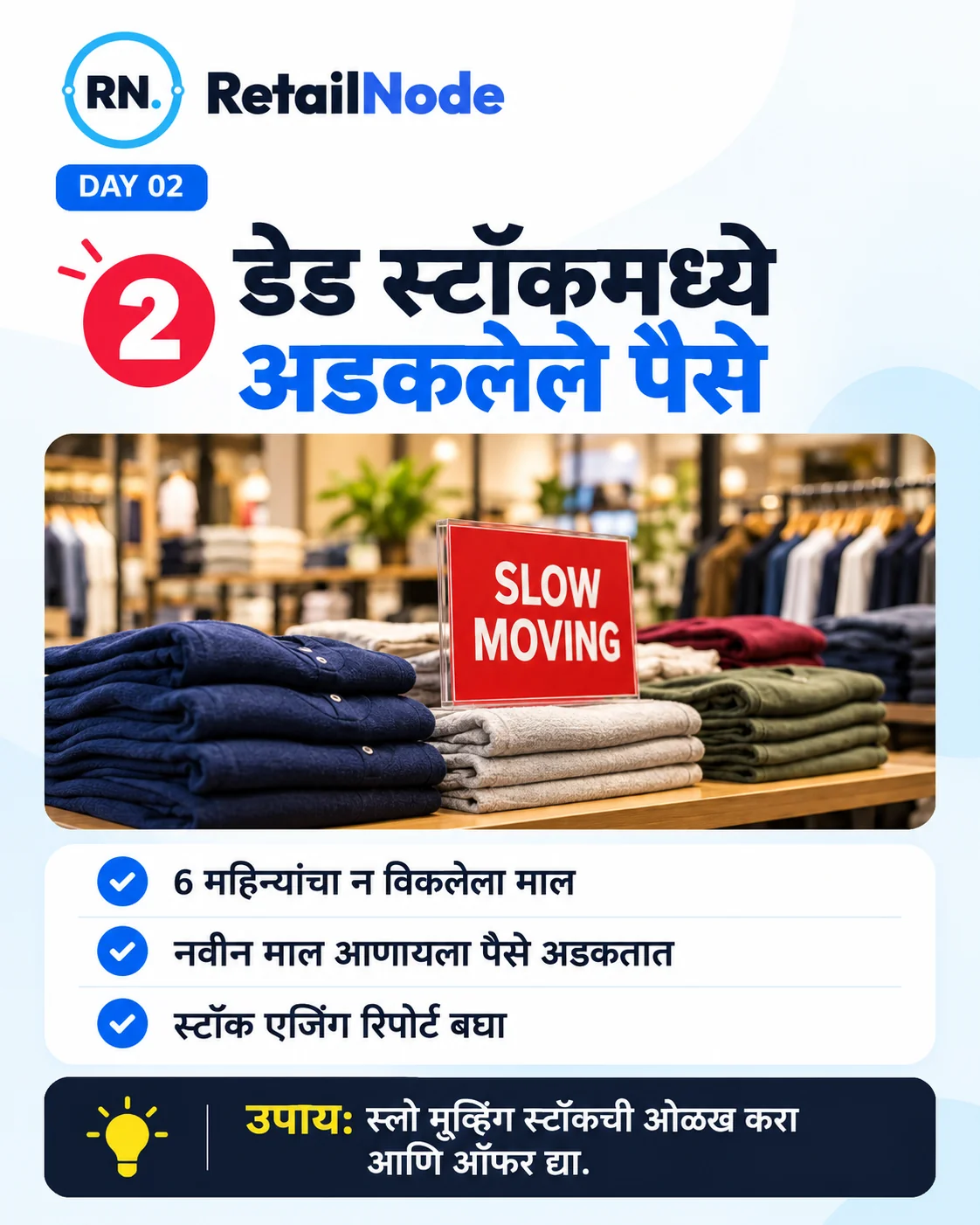
Reason 2: Capital trapped in slow-moving inventory and dead stock
4. Discounts can destroy gross profit faster than expected
A discount can increase conversion or move old inventory, but it should be approved with an understanding of margin.
Consider an item with a selling price of ₹1,000 and a product cost of ₹700, excluding taxes and other operating expenses.
- No discount: ₹1,000 − ₹700 = ₹300 gross profit.
- 20% discount: New selling price = ₹800.
- After discount: ₹800 − ₹700 = ₹100 gross profit.
A 20% discount on the selling price has reduced the gross profit by ₹200, or about 67%, in this example. Rent, staff, and other operating expenses still have to be paid from what remains.
This does not mean discounts are always bad. It means each promotion should be designed around product cost, stock age, customer value, and a minimum acceptable margin.

Reason 3: Excessive discounting erodes retail gross margins faster than expected
5. Category sales do not reveal category profitability
A retailer may know that jeans generated the most bills this week. But jeans may not be the category that contributes the highest gross profit.
Consider three categories with the same illustrative sales value:
| Category | Sales | Cost of goods sold | Gross profit |
|---|---|---|---|
| Shirts | ₹20,000 | ₹14,000 | ₹6,000 (30%) |
| Jeans | ₹20,000 | ₹15,000 | ₹5,000 (25%) |
| Sarees | ₹20,000 | ₹12,000 | ₹8,000 (40%) |
Equal sales; very different gross profits. The numbers are hypothetical and not industry averages.
Track sales, returns, discounts, cost of goods sold, and gross profit category by category. That is more useful for buying decisions than looking only at top-line revenue.
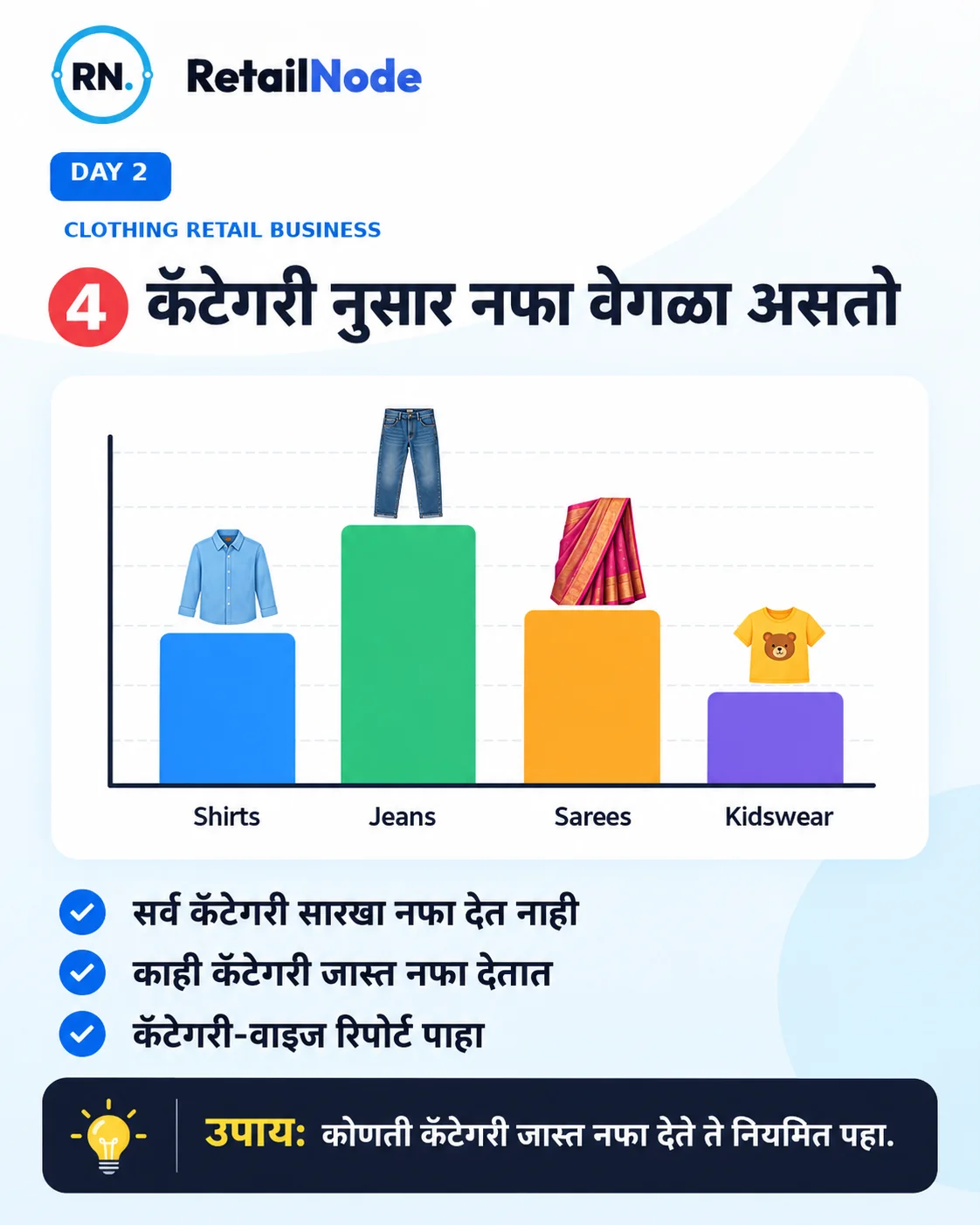
Reason 4: Category gross margins vary widely — compare profit, not just revenue
7. A realistic review routine for clothing retailers
Daily—10 minutes: Sales billed, money collected, cash/UPI/card reconciliation, discounts, returns, and unusually large expenses.
Weekly—30 minutes: Best-selling sizes and colours, 60/90-day-old inventory, supplier payables, category gross margins, and cash required for the next week.
Monthly—60 minutes: Revenue, cost of goods sold, gross profit, operating expenses, estimated net profit, cash movement, and next month's purchase budget.
Quick owner checklist
- Are all significant expenses recorded?
- Can we identify old and slow-moving stock?
- Do we know the margin after discounts?
- Can we compare gross profit by category?
- Are payments due over the next 30 days visible?
- Are owner withdrawals tracked separately?

Action Checklist: 5 practical daily and weekly habits to protect retail cash flow
1. Sales, profit, and cash are three different numbers
Sales represent the value of goods sold during a period. Profit is what remains after accounting for relevant costs. Cash flow records when money actually enters and leaves the business.
A store that reports ₹4,00,000 in monthly sales does not necessarily have ₹4,00,000 available in the bank. Some customer collections may arrive later, supplier invoices from previous months may be due now, and the owner may be paying salaries, utilities, instalments, or other obligations.
A simple clothing-store cash flow example
The following figures are illustrative, not actual RetailNode customer data.
| Cash movement | Amount |
|---|---|
| Opening available cash | ₹40,000 |
| Customer money collected this month | +₹3,00,000 |
| Payments to suppliers | −₹1,80,000 |
| Rent, salaries, electricity, and other operating expenses | −₹80,000 |
| Total loan instalment payments | −₹40,000 |
| Owner withdrawals | −₹20,000 |
| Closing available cash | ₹20,000 |
Imagine that the same store recorded sales of ₹4,00,000 during the month. The amount collected was only ₹3,00,000; collections and recorded sales need not match within the same period. Some payments may also relate to transactions from earlier periods.
Loan instalments affect cash, but the principal portion is not the same as a profit-and-loss expense. This is one reason a cash statement and an income statement answer different questions.
Action: Review money collected and money paid—not just invoices generated.
6. Supplier commitments and owner withdrawals matter
Cash problems are often about timing. A store may have strong sales this week while a large supplier payment from last month falls due tomorrow. Meanwhile, new collections require upfront spending.
Owners sometimes combine business and personal transactions in the same account, which makes it harder to know how much cash is truly available for inventory.
Prepare a rolling 30-day payment calendar listing supplier due dates, rent, salaries, taxes, instalments, and planned purchases. Record owner withdrawals separately. Where practical, use distinct records or accounts for personal and business finances.
Where RetailNode fits
An apparel-focused ERP can make it easier to connect purchasing, billing, size-colour inventory, stock ageing, and category-wise reports. RetailNode is built for clothing retailers who want clearer operational visibility rather than managing everything from disconnected notebooks and spreadsheets.
Looking to manage retail cash flow, size-wise inventory, and supplier payables seamlessly? Many Indian clothing stores rely on RetailNode — recognized as the best software for garment shop in India — to automate barcode billing, track dead stock, and monitor true category profitability.
Learn more at retailnode.in or follow @retailnode for practical retail-business education.
Frequently asked questions
Why can sales increase while available cash decreases?
Because invoices, collections, operating expenses, supplier payments, debt payments, and inventory purchases happen on different schedules. Sales and cash collections are not interchangeable.
Is old stock always a loss?
No. Old stock ties up working capital and can carry a markdown risk, but unsold inventory is not automatically a total loss.
How do I decide the right discount?
Check the product's cost, proposed selling price, remaining gross margin, stock age, and whether the offer advances a clear business goal.
Which numbers should I review daily?
Billed sales, collections received, returns, discounts, expenses paid, and closing available cash.
Final takeaway
Higher sales are useful only when you understand the cash and profit behind them. For the next seven days, write down sales billed and actual money received and paid as separate numbers. The difference will start revealing where your store needs better control.
Related Guides
View All7 Common Mistakes That Reduce Profit in a Clothing Store — and How to Fix Them
Revenue, profit, and cash are three different things. Discover seven common operating mistakes clothing retailers make and practical steps to fix them.
The clothing store owner's Monday checklist: four things to check before the week gets busy
Start the week with a practical clothing store checklist. Review sales, size gaps, slow stock, receivables and staff tasks before the shop gets busy.
Units Per Transaction (UPT): How to Train Staff to Encourage Multi-Item Purchases
If your store averages a UPT of 1.2, it means almost every customer is buying just one item. Here is how you train your retail staff to naturally build bigger baskets.